The act of discarding carries an implicit premise: once something leaves our hands, it is finished. Whether placed in a bin, carried out to sea, or buried in the ground, it is no longer part of our world. What we call disposal is, in fact, a form of belief; a belief which claims that beyond the human sphere there is nothing; that even if something exists, nothing occurs.
Yet what is discarded does not disappear. It encounters nature.
Nature does not judge as humans do. It does not distinguish between benefit and harm, nor does it strive to preserve what is alive or avoid what is dead. It does not respond according to moral categories of good and evil. It simply absorbs what comes into being and carries it forward into another state. It breaks down plastic into micro-particles through weathering, circulates pollution through water, soil, and living bodies, and absorbs emitted carbon, consequently altering the climate in the process. Nature does not move toward what humans would call recovery or restoration. Rather than returning to the past, it continuously activates what is possible within given conditions.
In this sense, nature is not a backdrop. It is an active agent that takes in what humans leave behind and rewrites the world anew.
This exhibition emphasizes this process: a nature that, without intention, judgment, or refusal, takes up everything humans discard, yet nevertheless circulates it back to the human itself.
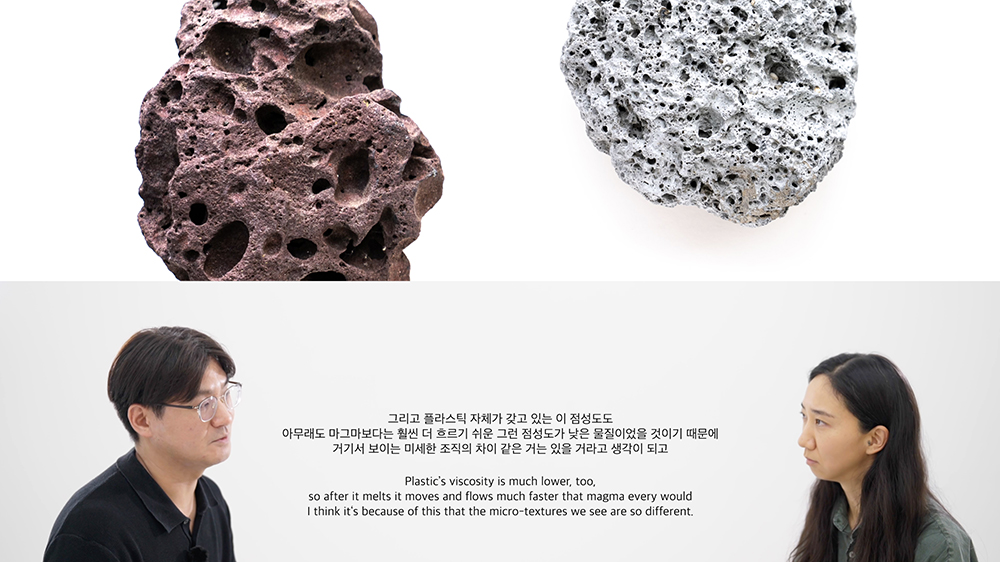
The video work Same or Different (2000), which is projected across the floor, traces how the processes by which nature forms rocks are repeated upon plastic. The cooling and solidification of magma, the formation of surface textures, and the patterns of weathering – processes that give rise to igneous rock – are similarly reenacted in plastic, to the point that the two become nearly indistinguishable in appearance. While natural stone arrives at its present form over vast stretches of time, ‘new rock’ reaches a comparable state in mere decades. Their outward forms may converge – yet their origins, temporalities, and subsequent impacts on nature remain fundamentally different. Materials produced by humans do not remain outside of nature; they have already entered deeply into its operative systems.
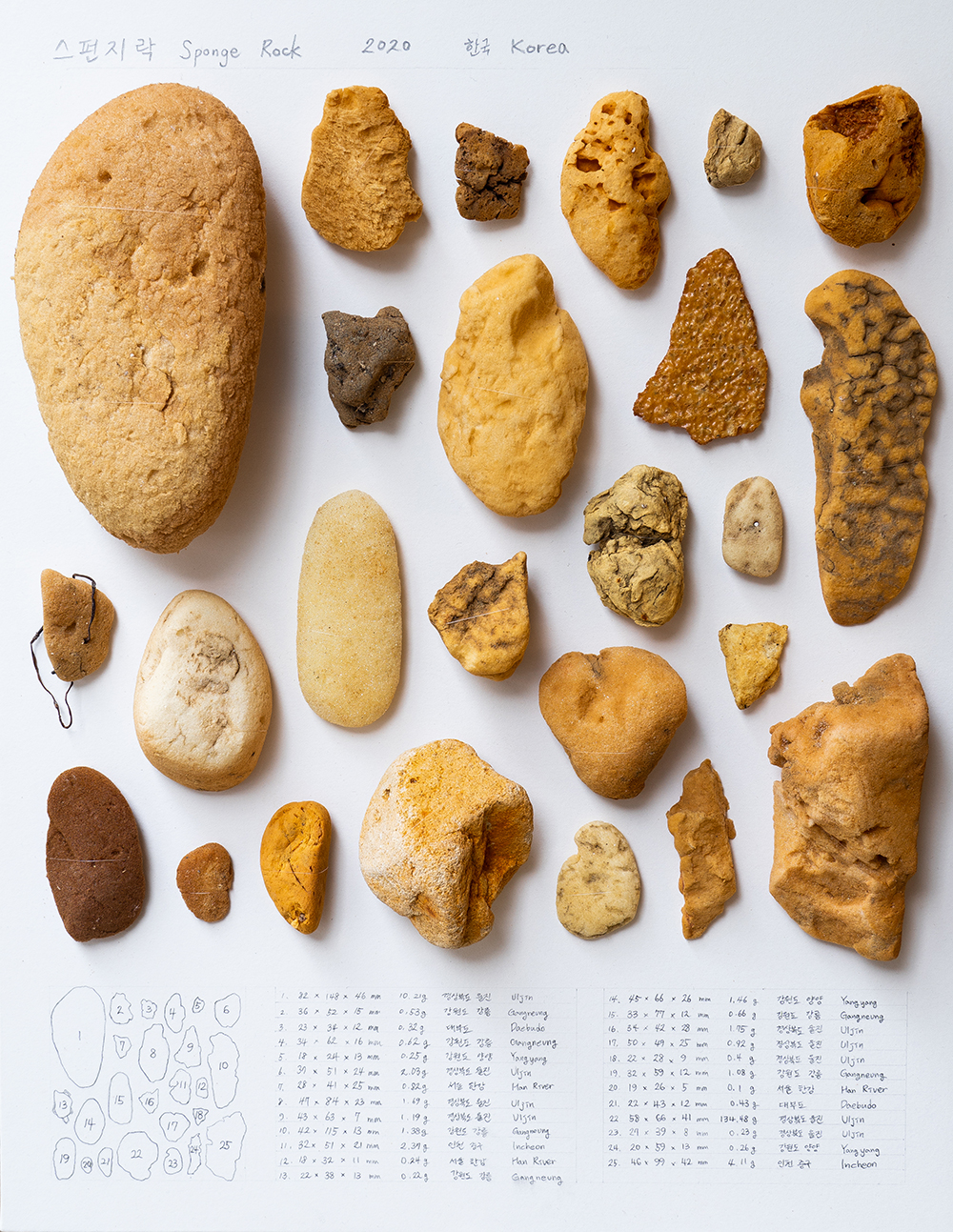
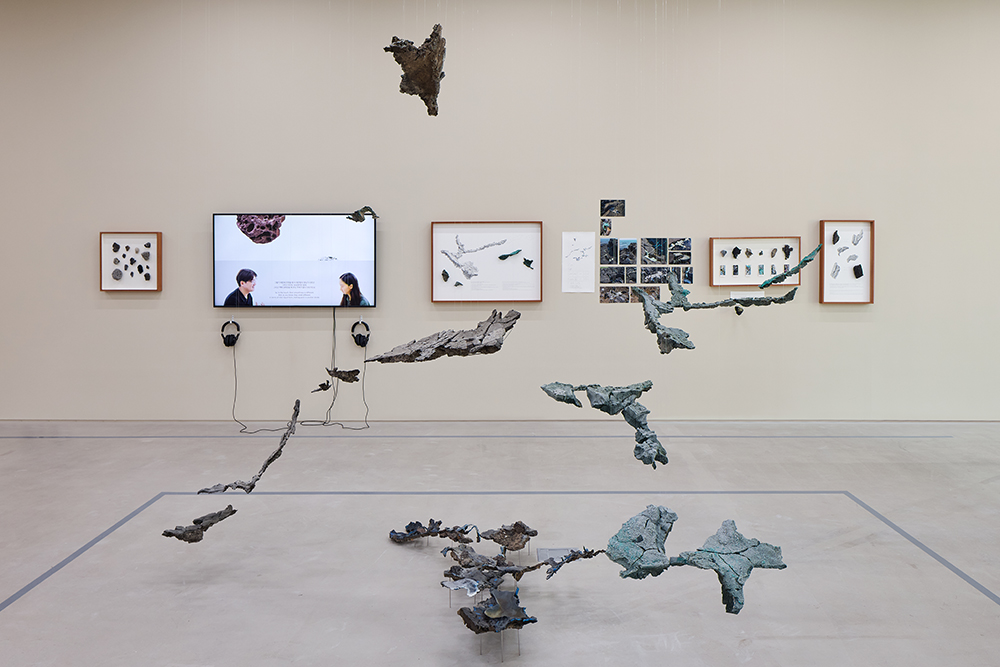
The exhibition Humans Treat Nature. Nature, Too, Treats Humans. unfolds this process through a series of concrete examples. What humans produce does not remain as inert waste; within natural processes, it becomes new material. Some of it solidifies into matter (like ‘new rock’) and leaves geological traces; some enters the bodies of living organisms, correspondingly reshaping them; whilst some gives rise to entirely new conditions of survival. What is discarded thus transforms into material, into body, into condition. Within this space, handwritten texts, specimens, and drawings trace how nature absorbs and reconfigures the remnants of human activity.
In the installation space bearing the same title To Be Discarded Is to Be Placed in Nature, explanation becomes obsolete. New rocks lie on sand, others rest in water, plants emerge alongside them, and the sounds of nature flow through the space. Wind weathers down plastic stones, water envelops the artificial, and plants grow in their midst. In this landscape, where distinctions between the natural and the artificial dissolve, everything is simply conjoined together – an arrangement that more closely reflects how nature operates today. Here, the viewer begins to sense, almost imperceptibly, the fading of the belief that one stands outside of nature.
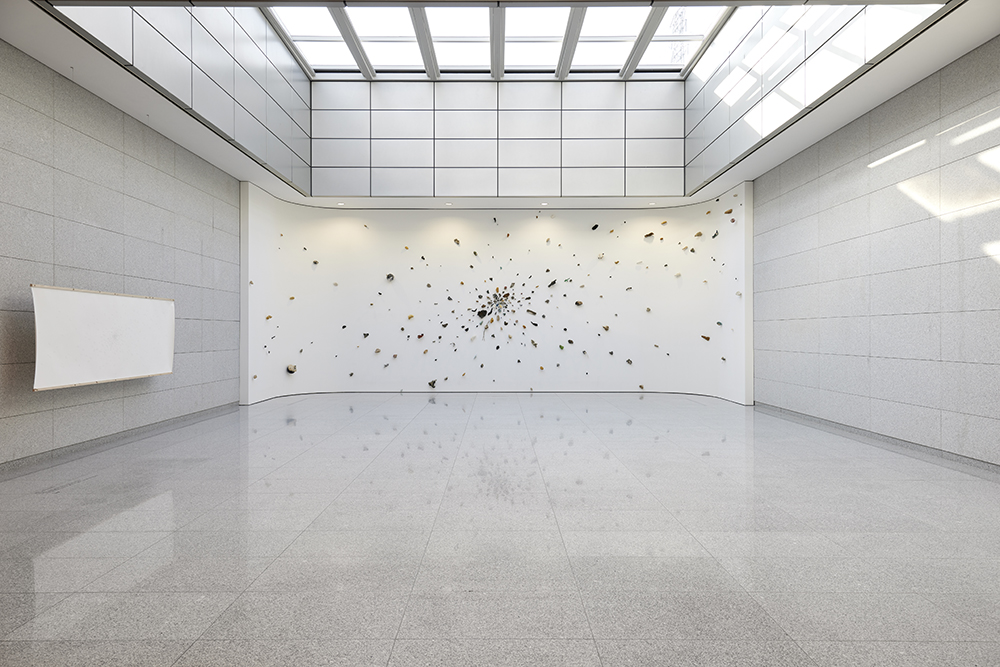
The final work, Bang (2020), compresses these processes into a single moment. Hundreds of new rocks spread across the white wall – like an explosion, or the result after one has just ceased. What humans have expelled returns to them through the cycles of nature. The climate altered by human activity, in turn, reshapes the conditions of human life; materials left behind by humans re-emerge before them, having assumed new states within nature.
Humans act upon nature. Yet nature, as a consequence, acts upon humans.
This exhibition does not position the human as a sovereign outside of nature. Rather, it perceives the human as a being shaped within nature’s operations; affected by it and continually reconditioned in return. What we believe we have discarded circulates within nature and extends back to ourselves. This exhibition renders visible that returning process.
Hanna Chang is an artist who investigates how materials produced by humans come to exist in new forms within nature. Her work attends to the ways in which the byproducts of human desire and systems of production do not simply disappear as waste, but are rather transformed through natural processes and reappear before us in altered states. This line of inquiry, grounded in practices of collection, observation, research, and documentation, extends across a range of media, including photography, drawing, installation, and video.
Hanna Chang’s representative project, New Rock, centers on plastics that have undergone weathering and transformation in natural environments, coming to resemble stone. The artist collects these materials from coastlines and various sites across the country, presenting them as contemporary specimens that stimulate a reconsideration of conventional frameworks that separate the human from nature. New Rock exists as both an artificial product of human activity and as a material already incorporated into natural cycles. Through this work, Chang reveals that nature today can no longer be understood as a pure domain existing outside the human.
She has held several successful solo exhibitions including New Rock (Clayarch Gimhae Museum, 2023), The Birth of a New Nature (Mudaeruk, 2023) and New Nature, New Land Art (Chilsung Boat Yard, 2024). She has also participated in numerous group exhibitions, such as Young Korean Artists 2025: Here and Now (National Museum of Modern and Contemporary Art Korea, 2025) Random Access Project 4.0 (Nam June Paik Art Center, 2025) and Equity: Peaceful Strain (Gwangju Biennale Pavilion, 2025).


