Hyung Jin Park is an artist who moves beyond an anthropocentric and observational gaze to explore the subtle changes through which nature reveals itself, along with the temporality accumulated within them. Departing from her earlier practice that was rooted in urban contexts and concerned with human perspectives and the logic of development, her relocation of the studio to the periphery marked a significant shift in focus toward the colors, energies, and the continuously mutating movements of nature. In this context, landscape is no longer an objectified image, but functions as a field of time that discloses itself.
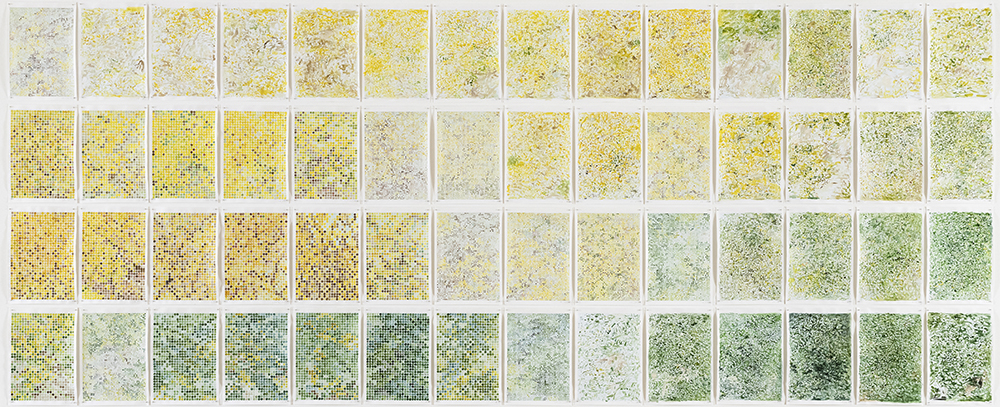
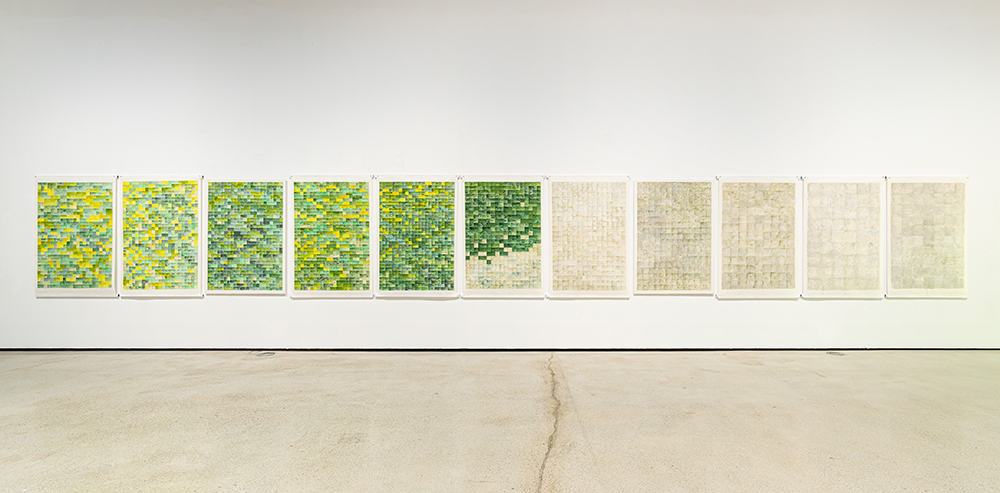
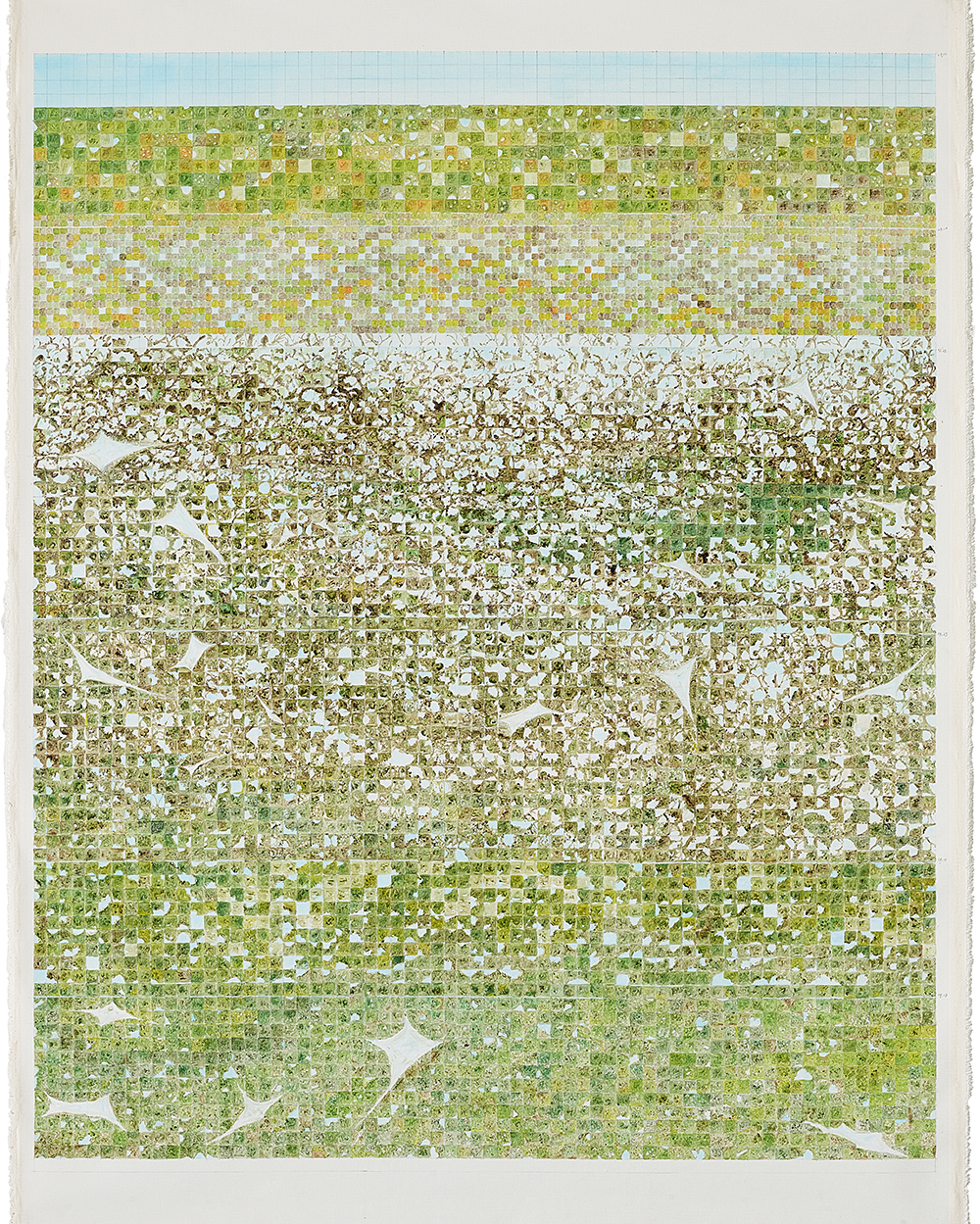
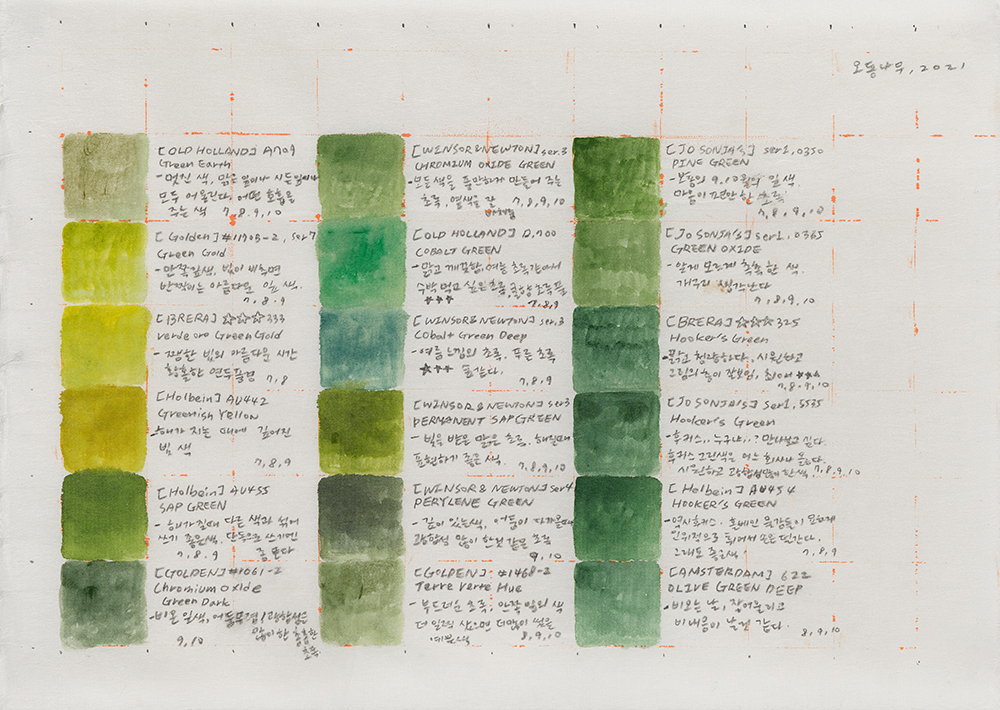
Through a repetitive practice of daily observation and the accumulation of drawings, the artist captures the flows of change that are not easily perceptible. She makes evident that the transformations of nature do not become immediately visible; the transitions of seasons and processes of growth reveal themselves only through sustained observation and recording over time. In order to inscribe this density of time onto the pictorial surface, her artwork therefore introduces a set of artificial coordinates on a grid, in which the recurring dots of color and circular forms placed upon it are not merely formal elements, but traces in which observation, accumulation, and the duration of waiting are condensed. Color, in turn, functions as a device of sensory translation, transforming the changes of nature into a synesthetic experience.
Central to her practice is this sense of performativity. Park asserts that this daily repetition is not merely habitual, but a methodology for adapting to deferred time. The images that emerge in this process correspondingly take the form of fragmented traces that remain closely interconnected. Each dot and mark do not exist in isolation; it acquires meaning only through its relations. This reflects not only the mode of existence of nature, but also serves as a metaphor for the way we, too, exist in time; sustained through our interdependence.
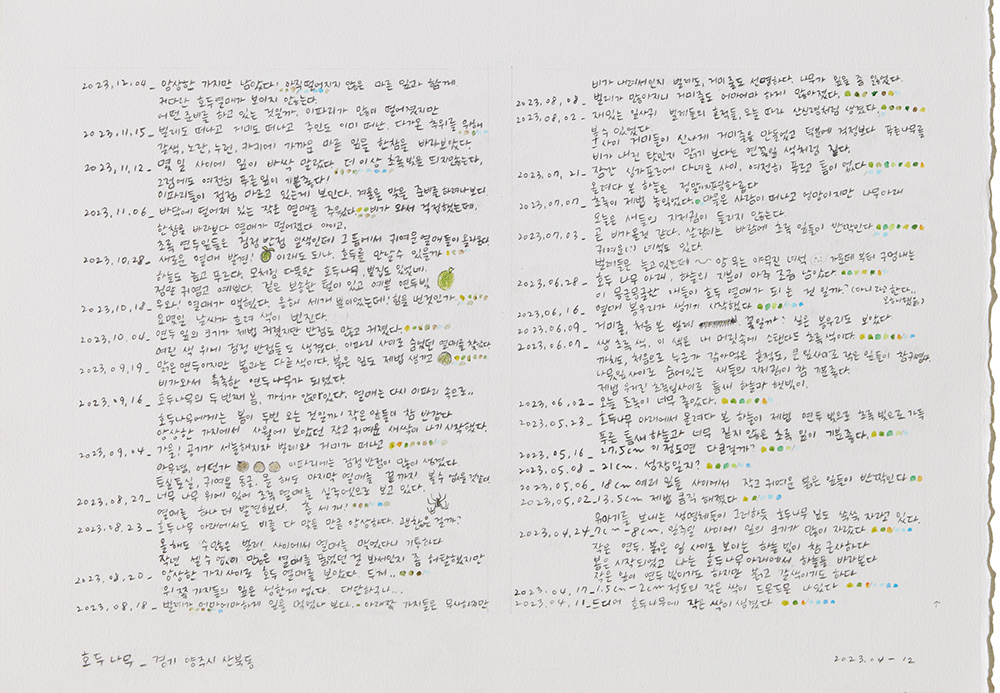
Her exhibition is significant in that it presents the accumulation of time in a form condensed within a single space. In particular, nature’s transformation over the course of a year is trajected and unfolded immediately at a glance: beginning with Garden of Korean Forsythia (2021) in Spring, then moving through the deepening verdure of Summer in Paulownia, July to December (2021), and finally arriving at the season of Autumnal foliage in Walnut Tree, August to September (2024). This cyclical passage of time and seasons therefore coexists within one spatial frame, guiding the viewer along the traces of time that the artist has recorded through a practice akin to ritual. In our daily lives, we tend to pass over subtle shifts such as the changes in weather, the density of green, the texture of wind, the direction of sunlight without much notice. Yet by encountering her works, these overlooked transformations come to be recognized anew through Walnut Tree Document (2023) as events of remarkable delicacy and density. In this sense, Hyung Jin Park’s work extends beyond the mere representation of nature; it becomes an experience that invites us to relearn how to exist in time whilst also changing alongside it.
Hyung Jin Park received both her MA and Ph.D. in Oriental Painting from Sungshin Women’s University, and has continued to develop a painting practice grounded in the sustained observation and recording of everyday landscapes. Her major solo exhibitions include Other Times Another Time (Gyeonggi Museum of Modern Art, 2022), A Crow and a Magpie (Sahng-up Gallery, 2022), and Emptiness sitting like green (on-ground Gallery, 2019), among others. She has also participated in numerous group exhibitions including Ready…Set…Color (Jeonnam Museum of Art, 2025), Dear My Forest (MMCA, Korea Children’s Museum, 2024), 《 Pome and Circumstance》(Kim Hong Do Art Museum, 2022), When the World Stops Turning (Starch, Singapore, 2024), DMZ Exhibition: Checkpoint (Camp Greaves, Paju, 2023), The 4th Seoul Biennale of Architecture and Urbanism (Songhyeon Green Plaza, 2023), Contourless (West Bund Art Center, Shanghai, 2022), Jeonnam International SUMUK Biennale (Mokpo Biennale Exhibition Hall 3, 2021) and In Bloom (HITE Collection, Seoul, 2021). In addition, he has been recognized for the continuity and contemporary significance of his practice through selections and awards such as the SONGEUN Art Award, ARKO Creative Academy, the Seoul Foundation for Arts and Culture Grant for Artistic Creation, OCI Museum of Art Residency, and the Seoul Art Space Geumcheon Residency.


